

Bioorthogonal Fluorescent Labeling: When Click Chemistry Improves Selectivity and Flexibility
Bioorthogonal fluorescent labeling is increasingly used when conventional fluorescent conjugation does not provide enough control over where the label is introduced, how much off-target modification occurs, or how flexibly the workflow can be adjusted after target preparation. In traditional labeling routes, fluorophores are often attached through broadly distributed native groups such as amines or thiols. Those routes remain useful in many standard workflows, but they can also generate heterogeneous products, broaden labeling-site distribution, complicate structure-function interpretation, and restrict the user to installing the fluorophore earlier than is ideal. Bioorthogonal strategies address these limitations by relying on reaction partners that are largely absent from endogenous biological chemistry, which reduces competition from naturally occurring groups and creates a cleaner path to selective fluorescent installation.
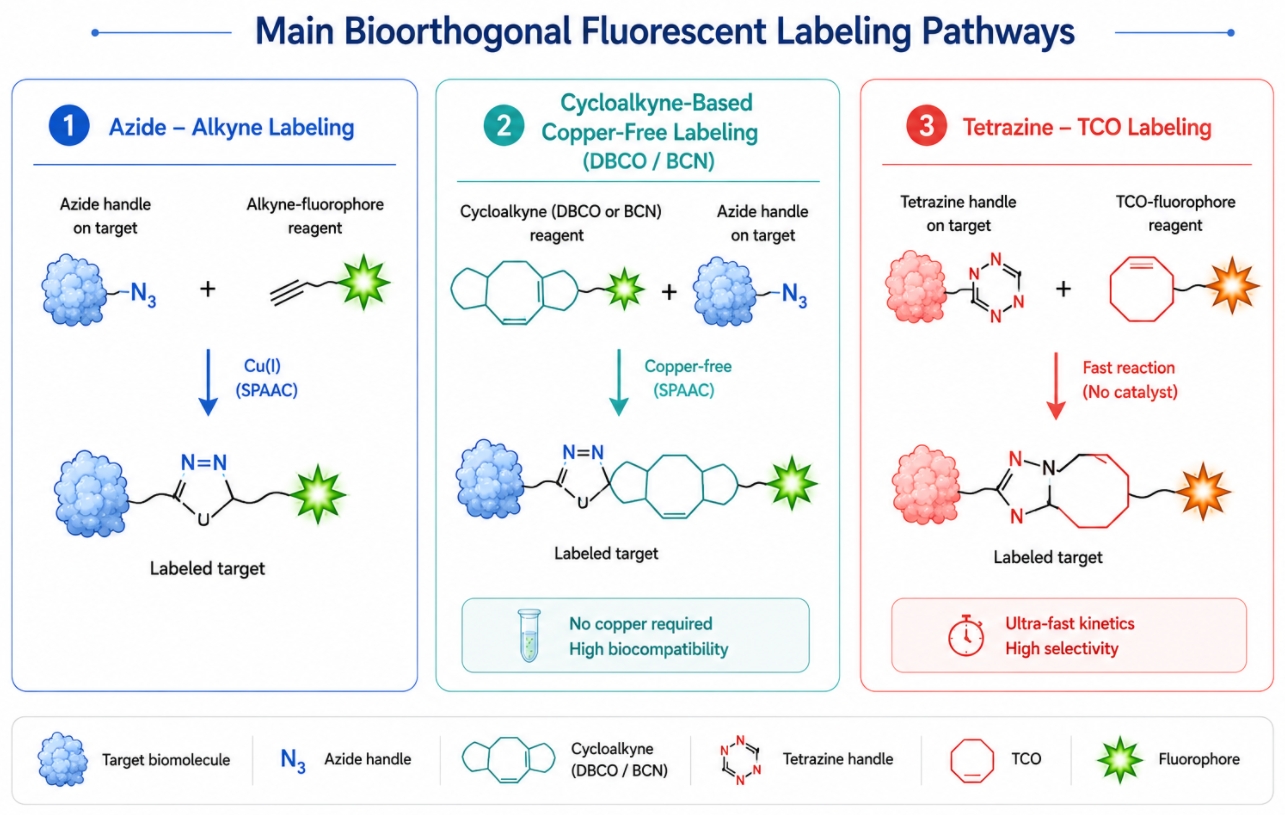 Fig. 1. Bioorthogonal fluorescent labeling includes several selective reaction pairs (BOC Sciences Authorized).
From a development standpoint, the value of bioorthogonal labeling is not limited to selectivity alone. Its practical strength lies in separating target preparation from fluorescent readout. A small chemical handle can first be introduced into the molecule or system of interest, and the fluorophore can then be attached at a later stage under conditions chosen for optical fit, channel design, sample readiness, or assay timing. That staged logic becomes especially useful when direct dye installation risks altering target behavior, when the sample environment is chemically crowded, or when the final fluorophore still needs to be chosen according to instrument compatibility and multiplex design. For customers building adaptable labeling workflows rather than one-off conjugates, this two-step architecture often provides a more controllable balance of selectivity, modularity, and downstream interpretability than direct fluorescent attachment alone.
Why Bioorthogonal Fluorescent Labeling Matters?
Bioorthogonal labeling matters because it solves a set of problems that become more visible as fluorescent labeling workflows grow more complex. In simple systems, direct conjugation can be entirely adequate. In more demanding systems, however, users often need higher reaction selectivity, lower target perturbation, more freedom in fluorophore timing, and cleaner integration into multistep analytical workflows. Bioorthogonal design becomes valuable when the chemical logic of the labeling route matters just as much as the optical properties of the final dye.
- Selectivity Beyond Conventional Reactive Labeling: Standard fluorescent labeling often depends on native groups that are chemically common across proteins, peptides, antibodies, or other biomolecules. That broad reactivity can be useful for convenience, but it also reduces positional control and increases the chance of heterogeneous labeling populations. Bioorthogonal chemistry improves selectivity by using reaction pairs that are minimally represented in natural biomolecular structures, so the intended handle is much more likely to react without substantial competition from endogenous chemistry. In practical development work, this can reduce unwanted side labeling, narrow product heterogeneity, and improve confidence that the final fluorescent signal truly reflects the designed modification rather than widespread incidental reactivity.
- Flexibility Through Two-Step Labeling Design: A major advantage of bioorthogonal labeling is that handle installation and fluorophore attachment can be planned as separate operations. This allows the first step to be optimized for target compatibility and the second step to be optimized for readout quality. From a customer perspective, this is valuable because the target-bearing intermediate can often be prepared once and later paired with different fluorophores depending on the imaging system, multicolor panel, or assay branch that ultimately needs to be supported. That kind of workflow flexibility is difficult to achieve when the fluorophore is introduced too early and becomes structurally inseparable from the targeting step.
- Why Small Handles Change Workflow Options: Many bioorthogonal handles, such as azides or alkynes, are much smaller than full fluorophores and therefore impose less steric and physicochemical burden on the target during the early stages of preparation. This matters when the target is structurally sensitive, when binding surfaces must remain accessible, or when direct installation of a large fluorophore could alter distribution, affinity, or conformational behavior. Using a small handle first often preserves more of the target's original function and leaves fluorophore choice open until later. In development terms, this expands design options because target optimization and fluorescent optimization no longer need to be solved in the same chemical step.
Click Chemistry Reagents as an Integrated Bioorthogonal Toolkit
In real development workflows, bioorthogonal fluorescent labeling rarely depends on a single reagent category alone. It typically requires a coordinated combination of handle-installation chemistry, ligation partners, and fluorophore-bearing reagents. This is why a broader click chemistry reagents toolkit is often the most practical way to evaluate route design. Customers may need azides or alkynes for initial handle placement, DBCO or BCN reagents for copper-free ligation, tetrazines and TCO for fast two-step assembly, and upstream functionalization tools such as phosphoramidites, triphosphates, NHS esters, or hydrazides depending on the target class. Looking at these reagent families as one integrated toolkit makes it easier to build a bioorthogonal fluorescent labeling workflow that is selective, modular, and technically aligned with the real project rather than assembled step by step without a complete design strategy.
Azides and Alkynes as Core Click Handles
Azides and alkynes are the most familiar starting point in bioorthogonal fluorescent labeling because they provide a compact and highly modular handle pair. These groups are frequently used when the target needs to carry a minimally disruptive clickable moiety before the fluorescent dye is introduced in a later step. In practical workflow design, azides are often favored for their small size and broad compatibility with staged labeling strategies, while alkynes remain equally important as complementary partners in modular conjugation routes. For customers building a flexible click-based system, azides and alkynes are often the foundational reagents that make it possible to separate target preparation from fluorophore installation and preserve more freedom in later assay development.
Cycloalkyne Dyes (DBCO) and BCN Reagents for Copper-Free Ligation
Cycloalkyne-type reagents are especially important when the workflow benefits from copper-free click chemistry. In these systems, strained cycloalkynes such as DBCO or BCN can react directly with azide-bearing targets, allowing fluorescent ligation without introducing a catalytic metal step during the final reaction. This is often attractive when the project needs cleaner operational handling, simpler late-stage labeling, or a route that fits more comfortably into sensitive or multistep assay conditions. From a development perspective, DBCO-bearing fluorescent reagents are particularly useful because they combine the click partner and the dye in one reagent, while BCN reagents provide another strained-handle option when customers need a copper-free route but want flexibility in how the final ligation pair is built.
Tetrazines and Trans Cyclooctene (TCO) for Fast Two-Step Labeling
Tetrazine-based systems and strained alkene partners such as TCO are among the most useful bioorthogonal reagents when rapid and highly selective late-stage fluorescent installation is required. These reagent classes are particularly valuable in workflows where the handle-bearing target should remain minimally perturbed until the final signal is introduced. In practical labeling design, tetrazines are often incorporated into the fluorescent reagent side of the system, while TCO is introduced into the target-bearing intermediate, although the architecture can also be reversed depending on the application. For customers comparing click strategies, tetrazine–TCO systems are often chosen when the workflow needs a fast final ligation step, strong modularity, and better control over when fluorescence is actually installed.
Phosphoramidites and Triphosphates for Nucleic Acid-Oriented Bioorthogonal Labeling
Not all bioorthogonal fluorescent labeling begins with direct protein or small-molecule conjugation. In nucleic acid-focused workflows, phosphoramidites and triphosphates can play an important upstream role by introducing clickable or fluorophore-ready functionality during oligonucleotide synthesis or nucleotide incorporation. Phosphoramidites are especially relevant when customers want to build clickable nucleic acid sequences in a controlled synthetic manner, while triphosphates can be important when labeled or handle-bearing nucleotide units need to be incorporated through enzymatic or related workflows. From a development standpoint, these reagent classes extend bioorthogonal fluorescent labeling beyond simple post-synthetic ligation and make it possible to design more structured nucleic acid labeling systems in which the clickable handle is embedded during sequence construction rather than appended only at the final stage.
NHS Esters and Hydrazides as Upstream Functionalization Tools
Although NHS esters and hydrazides are not themselves the classic terminal click pair in most bioorthogonal workflows, they are often important supporting reagents because they help install or connect the chemical elements needed before the click ligation is performed. NHS esters are widely used to functionalize amine-containing molecules and can be valuable when a clickable handle, spacer, or precursor group needs to be attached to a biomolecule in an upstream step. Hydrazides can play a similar enabling role in workflows where carbonyl-reactive derivatization is useful for introducing a later click-compatible element or building a more elaborate fluorescent conjugation sequence. For customers designing a complete bioorthogonal labeling route, these reagents often serve as bridge chemistries that help convert a native target into a handle-bearing intermediate suitable for more selective click-based fluorescent installation.
When Click Chemistry Outperforms Direct Fluorescent Conjugation?
Bioorthogonal labeling is not inherently superior to direct fluorescent conjugation in every situation. Direct routes remain efficient and cost-effective in many standard workflows. The advantage of click-enabled design becomes clearer when conventional chemistry introduces too much ambiguity, too much target disturbance, or too little flexibility in when and how the fluorophore is attached. In those cases, click chemistry stops being an added complication and becomes a practical solution to a real development constraint.
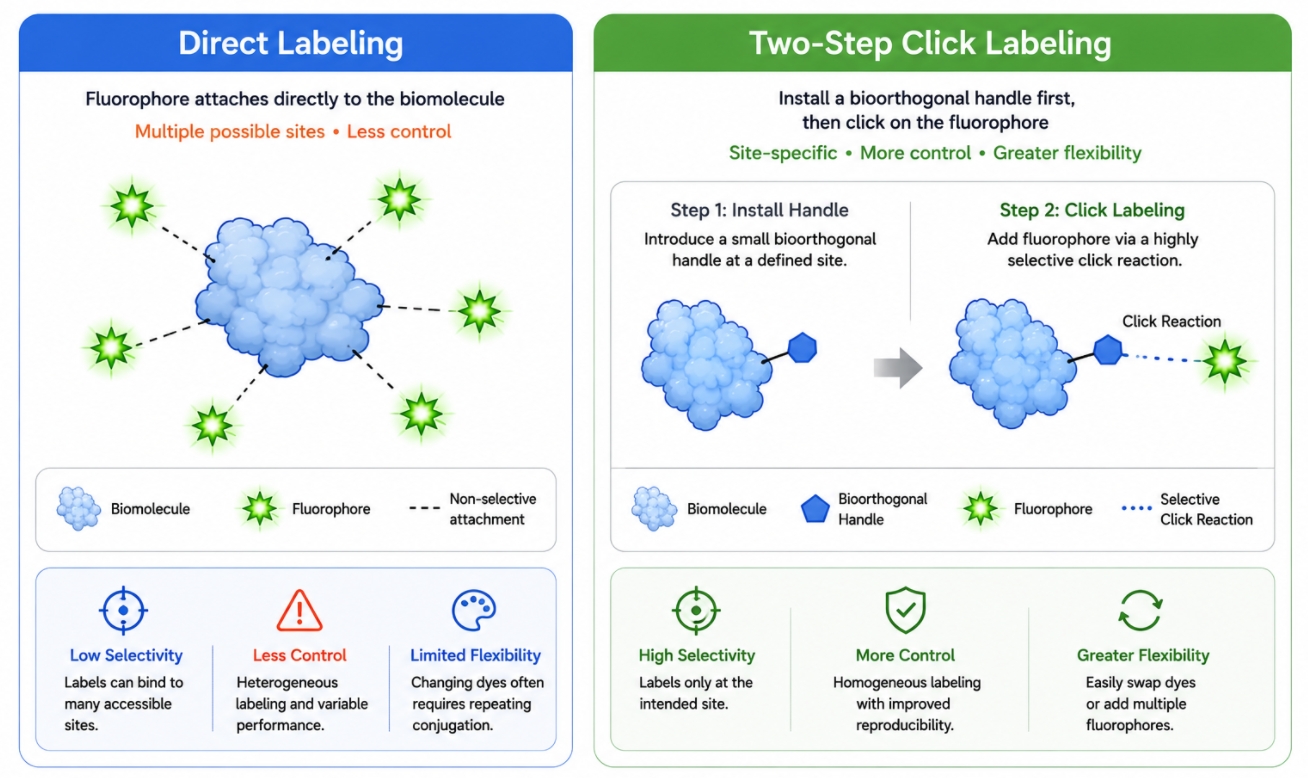 Fig. 2. Two-step click labeling can improve selectivity and workflow flexibility (BOC Sciences Authorized).
When Native Functional Groups Are Too Common
Direct fluorescent conjugation often relies on functional groups that are chemically abundant across the target or surrounding biomolecular environment, especially amines and accessible thiols. That broad distribution can create labeling-site heterogeneity, reduce control over product uniformity, and complicate interpretation when the labeled construct is expected to behave consistently. Bioorthogonal routes become more attractive when the customer needs a more uniquely addressable site or a labeling event that is less likely to be diluted across many reactive positions. In these cases, introducing a dedicated handle can improve not only selectivity but also batch-to-batch consistency, because the chemistry is no longer competing with a large and variable background of native reactive groups.
When Target Perturbation Must Be Minimized
In some projects, the most important question is not whether a fluorophore can be attached, but whether attaching it directly will distort target function, accessibility, or distribution. This is particularly relevant for structurally sensitive proteins, smaller ligands, peptides, or other systems in which a bulky fluorophore may alter the behavior that the experiment is supposed to observe. A small bioorthogonal handle is often less disruptive at the early stage, allowing the target to be prepared in a more native-like state before fluorescence is introduced. For customers developing performance-sensitive labeled constructs, this staged reduction in structural burden can be more important than the convenience of direct conjugation.
When Sequential Labeling Improves Control
Two-step workflows outperform direct labeling when the project benefits from separating target preparation from optical decision-making. The first step can be optimized for chemical compatibility and target retention, while the second can be optimized for fluorophore family, wavelength range, photostability, or instrument compatibility. This is especially valuable in development pipelines where the targeting element may be finalized before the imaging platform, multicolor panel, or final assay conditions are fully fixed. For customers managing evolving workflows, sequential labeling preserves flexibility and reduces the need to redesign the entire targeting architecture every time the desired fluorophore changes.
When Antibody or Direct Dye Routes Are Not Ideal
There are cases where antibody-driven or direct dye labeling routes become limiting because they are too rigid, too background-prone, or too difficult to adapt to later-stage workflow changes. This may happen when panel design is already crowded, when direct fluorophore installation broadens nonspecific signal, or when the target must be modified in one phase of the project and visualized in another. In these settings, bioorthogonal labeling adds value by decoupling target preparation from fluorescent output. That added flexibility can help customers preserve more options during method development, especially when the final analytical context is not yet fully fixed at the time the target-bearing construct is first prepared.
Evaluating bioorthogonal fluorescent labeling for a new project?
We can help compare click-compatible routes, match reactive pairs, and select fluorophores for more selective and flexible labeling workflows.
How to Choose a Bioorthogonal Labeling Pair?
Choosing a bioorthogonal labeling pair is not simply a matter of selecting a popular click reaction. The right choice depends on how the handle will be installed, how sensitive the target is to structural modification, whether the workflow benefits from catalyst-free ligation, and how late the fluorophore should enter the system. For customers building practical fluorescent labeling workflows, this decision affects not only reaction efficiency, but also background control, reagent compatibility, downstream cleanup, and how easily the route can be adapted as the project evolves. A technically strong pairing strategy should therefore be judged by how well it supports the full workflow rather than by reaction class alone.
Choosing Between CuAAC and Copper-Free Routes
One of the first decisions is whether the labeling workflow should rely on a catalyst-assisted azide-alkyne reaction or move directly to a copper-free route. Catalyst-assisted systems can offer efficient ligation, but they also introduce an additional reaction variable that may complicate workflow design, compatibility assessment, and final validation. Copper-free systems are often more attractive when the goal is to keep the ligation environment simpler or when the final fluorescent step needs to fit more cleanly into a sensitive or multistep assay. From a customer perspective, this choice is rarely only about chemical mechanism. It is about whether the workflow benefits more from catalytic efficiency or from a cleaner and more operationally flexible staged labeling process. In development settings, that trade-off should be evaluated according to actual target tolerance, workflow complexity, and how much extra reaction control the project can realistically support.
Matching Azides, Alkynes, and Cyclooctynes to Workflow Needs
The choice among azides, alkynes, and cyclooctynes should be guided by workflow architecture rather than by habit. Azides are often attractive because they are compact, chemically distinct, and easy to incorporate into modular labeling designs with limited structural burden. Alkynes provide similar modular value and may fit well when the target or intermediate is more compatible with that handle orientation. Cyclooctynes become especially useful when a catalyst-free final ligation step is preferred and the workflow benefits from a more direct handle-to-fluorophore connection. For customers, the practical question is not which of these groups is best in the abstract, but which one creates the most efficient relationship between target installation, final ligation, fluorophore choice, and downstream assay handling. A good pairing strategy should reduce friction across the workflow, not just deliver a successful reaction on paper.
Choosing Tetrazine-TCO or BCN Designs
Tetrazine-based systems and strained partners such as TCO or BCN often become more attractive when the project demands faster final ligation, stronger modularity, or a cleaner separation between target preparation and fluorescent readout. These routes can be particularly valuable in staged workflows where the handle-bearing intermediate needs to remain stable and minimally perturbed until the final signal is introduced. From a technical standpoint, these systems are often selected not only for selectivity, but also for how efficiently they support late-stage fluorescent installation under controlled conditions. For customers comparing bioorthogonal strategies, tetrazine- or BCN-based designs should be evaluated by the practical benefit they add to the workflow: whether they simplify later fluorophore installation, improve control over the labeling endpoint, or reduce the limitations seen with a more basic handle pair. The best choice is the one that improves the workflow meaningfully, not simply the one with the most advanced chemistry.
Selecting the Fluorophore After Handle Installation
One of the strongest advantages of bioorthogonal labeling is that fluorophore selection can be postponed until after the handle-bearing target has already been prepared. This creates real development flexibility because the dye can be chosen with better knowledge of instrument configuration, channel spacing, photostability needs, sample background, and overall assay design. For customers, this means one handle-bearing construct may support multiple fluorescent outcomes without requiring repeated redesign of the targeting step. Technically, this also improves troubleshooting, because target installation and fluorophore choice can be optimized separately instead of being locked into the same chemical event. A strong bioorthogonal pairing strategy should therefore be evaluated not only by how well the ligation works, but by how much useful fluorophore flexibility it preserves for later stages of the project.
Practical Limits of Bioorthogonal Fluorescent Labeling
Bioorthogonal labeling can improve selectivity and flexibility, but it does not remove the need for careful design. In many cases its value comes precisely from adding more design layers, and that benefit must be weighed against added validation burden. A balanced discussion should therefore acknowledge that bioorthogonal labeling solves important problems, but also introduces operational and development costs that are not present in simpler direct-labeling routes.
- Added Workflow Complexity: A two-step labeling route is almost never as operationally simple as a one-step direct conjugation workflow. Even when the final product is cleaner or more selective, the user must manage handle installation, ligation planning, possible intermediate cleanup, and final fluorescent validation. Each stage introduces another opportunity for incomplete conversion, variability, or workflow drift. For customers, this means bioorthogonal labeling is most justified when the added complexity creates a measurable gain in selectivity, target preservation, or modularity rather than being adopted only because it is chemically more advanced.
- Handle Installation Still Requires Good Design: Bioorthogonal chemistry does not compensate for poor handle strategy. If the handle is introduced inefficiently, positioned poorly, or installed in a way that perturbs target function, the final fluorescent ligation will not rescue the biological relevance of the construct. This is especially important in customers' development programs where early design decisions influence every later stage of validation. From a technical standpoint, the handle-bearing intermediate should be treated as a real engineered product that deserves its own optimization criteria rather than merely as a temporary precursor to the fluorescent endpoint.
- Reagent Pairing and Compatibility Constraints: Not all bioorthogonal reaction partners are equally interchangeable under real workflow conditions. Reaction speed, structural burden, storage stability, solubility profile, and target-environment compatibility can vary substantially across reagent families. A click-compatible fluorophore is only useful if it remains compatible with the installed handle and the assay conditions in which ligation must occur. For customers, this means reaction-pair selection should be treated as a system-level decision rather than a simple catalog substitution. The more demanding the downstream application, the more important this compatibility filtering becomes.
- Cost, Cleanup, and Validation Burden: More selective workflows often require more structured validation. In bioorthogonal systems, users typically need to confirm handle installation, verify successful ligation, assess signal specificity, and ensure that the staged workflow actually improves the final readout relative to simpler routes. Cleanup can also become more important because multistep systems create more opportunities for reagent carryover or partially converted species. For customers planning scalable or service-oriented workflows, this added burden is acceptable only when it produces a corresponding gain in readout quality, reproducibility, or platform flexibility.
How to Build a More Reliable Bioorthogonal Labeling Workflow?
Reliable bioorthogonal fluorescent labeling depends less on choosing a reaction class in isolation and more on designing a workflow in which target strategy, handle installation, fluorescent ligation, and detection logic reinforce one another. Customers usually obtain the most robust outcome when these design layers are planned as one integrated system rather than optimized independently without coordination.
1. Start with the Target and the Handle Strategy
The first design step should be deciding what the target is, where a handle can be introduced, and how much structural disturbance can be tolerated after modification. This choice has direct consequences for reaction efficiency, target integrity, and the interpretability of the final fluorescent readout. In proteins, the handle position may affect folding, solvent exposure, interaction interfaces, or accessibility to the later click step. In peptides and small molecules, the same handle can have a much larger proportional effect on binding, permeability, or distribution because the overall structure is smaller and more sensitive to modification. For customers developing bioorthogonal labeling workflows, this means handle strategy should not be treated as a simple precursor step before fluorescence is added. It should be evaluated as a core design layer that determines whether the later fluorescent ligation will remain selective, efficient, and biologically meaningful. In practical development terms, a good handle strategy is one that preserves target behavior, provides sufficient accessibility for the reaction partner, and supports reproducible installation across batches rather than merely allowing handle attachment in principle.
2. Define When the Fluorophore Should Be Introduced
One of the strongest advantages of bioorthogonal labeling is control over fluorophore timing, but that advantage only creates value when the timing is chosen deliberately according to the assay logic. In some workflows, it is preferable to delay fluorophore installation until the latest possible stage so that the target remains minimally perturbed during earlier preparation, transport, binding, or assembly steps. In other cases, earlier fluorophore introduction may be useful if the labeled construct itself must survive demanding downstream processing or if the customer needs to validate spectral behavior before committing to a larger workflow. The technically important point is that fluorophore timing affects more than convenience. It influences background risk, cleanup burden, signal retention, target perturbation, and even how easily the final result can be interpreted. For customers building staged labeling workflows, this means the fluorescent step should be placed where it provides the most analytical value with the least structural or procedural interference. A late-stage fluorophore installation may improve specificity and flexibility, but only if the handle-bearing intermediate remains stable enough to support that design.
3. Check Instrument and Spectral Fit Early
Even in a handle-based workflow, the final fluorophore still has to satisfy the same optical requirements as any other fluorescent label. Excitation source, emission window, channel separation, detector sensitivity, and planned multiplexing all determine whether a click-compatible dye is truly practical. This is especially important for customers who are attracted to bioorthogonal workflows because they want more flexibility in fluorophore choice. That flexibility is real, but it should be used strategically rather than left to the end of development. If the final dye is chosen too late without adequate spectral planning, the workflow may remain chemically elegant but optically suboptimal. In practice, early instrument-aware review helps avoid committing to a handle system that later forces the project into a crowded spectral region or into fluorophores with poorer photostability, higher background, or weaker detector compatibility. For customers building reusable or multi-platform reagents, early spectral review is also valuable because it helps determine whether one handle-bearing intermediate can realistically support several fluorophore outcomes without compromising the assay design.
4. Use Controls to Confirm Selective Signal
Bioorthogonal labeling is often chosen because it is expected to improve selectivity, so the workflow should include controls that directly test whether that selectivity is actually being achieved. A handle-negative control can help determine whether the fluorescent reagent is contributing nonspecific retention or background independent of the intended reaction pair. A fluorophore-only comparison can reveal whether the observed signal depends on true ligation or simply on the physicochemical behavior of the dye-bearing reagent. In multicolor systems, single-channel controls remain important because apparent background may still arise from overlap rather than from poor bioorthogonal specificity. For customers, these controls are not only good scientific practice but also important development checkpoints. They help determine whether the extra complexity of the bioorthogonal route is producing a real gain over simpler fluorescent conjugation methods. Technically, selective signal should mean that fluorescence tracks the designed reaction event more closely than it tracks free reagent persistence, sample stickiness, or optical bleed-through. Without that confirmation, a bioorthogonal workflow may look sophisticated while still behaving like a poorly controlled direct labeling system.
5. Optimize One Design Layer at a Time
Because bioorthogonal fluorescent labeling contains several interdependent design layers, optimization becomes much more informative when each layer is adjusted separately. Handle installation efficiency, reaction-pair choice, fluorophore-bearing reagent identity, cleanup conditions, and acquisition settings can all influence the final readout, but changing them all simultaneously makes it difficult to determine which parameter is truly limiting performance. For customers developing a reproducible workflow, this is a critical point. A one-time successful result obtained from multiple uncontrolled adjustments is much less valuable than a systematically optimized workflow in which the role of each variable is understood. Technically, layer-by-layer optimization also helps expose trade-offs that might otherwise be hidden. For example, a fluorophore change may improve apparent brightness but worsen nonspecific retention; a different ligation pair may improve conversion but increase structural burden; a stronger cleanup step may reduce background but also lower final signal yield. Sequential optimization makes these relationships visible and allows the workflow to be tuned for the customer's actual priority, whether that is selectivity, stability, multicolor compatibility, or scalability across repeated preparations.
How BOC Sciences Supports Bioorthogonal Fluorescent Labeling Projects?
Bioorthogonal fluorescent labeling projects often require more than selecting a click-compatible reagent. In many cases, the key challenge is deciding which handle strategy fits the target, which reaction pair supports the desired workflow, when the fluorophore should be introduced, and how to keep the final signal selective and practical for downstream use. BOC Sciences supports these projects through fluorescent labeling services that connect click chemistry design with fluorophore selection, conjugation planning, troubleshooting, and workflow development. The goal is to help customers build bioorthogonal fluorescent labeling routes that are not only chemically feasible, but also practical, reproducible, and aligned with real research demands.
Bioorthogonal Labeling Strategy Design
- Support for designing bioorthogonal fluorescent labeling workflows according to target type, handle installation logic, and downstream assay requirements.
- Comparative evaluation of direct fluorescent conjugation and staged click-enabled labeling when customers need better selectivity or more modular workflow design.
- Assistance with deciding when a staged fluorescent labeling route is more practical than conventional amine- or thiol-based attachment.
- Project-oriented planning that aligns click chemistry design with actual fluorescent labeling goals rather than treating bioorthogonal chemistry as a generic add-on.
Handle and Reagent Pair Matching
- Support for matching azides, alkynes, cyclooctynes, tetrazines, TCO, and related bioorthogonal partners to the target and workflow architecture.
- Assistance with choosing between catalyst-assisted and copper-free routes according to selectivity, operational simplicity, and development constraints.
- Guidance on selecting reagent pairs that support cleaner ligation, better staged control, and more practical downstream optimization.
- Better alignment of handle design and click-compatible reagent choice so that the final labeling route remains selective and reproducible.
Fluorophore Selection for Click Workflows
- Support for choosing Fluorescent Dyes for bioorthogonal labeling based on instrument fit, channel placement, photostability, and workflow timing.
- Assistance with selecting fluorophores after handle installation so that spectral design and assay needs are considered at the most useful stage.
- Guidance on choosing click-compatible fluorescent reagents for single-color or multicolor labeling systems.
- Better integration of fluorophore choice with click chemistry design so that selectivity and readout quality improve together.
Custom Development and Troubleshooting Support
- Support for custom fluorescent labeling development when standard click-compatible routes do not fully meet the target's structural or analytical needs.
- Assistance with troubleshooting low ligation efficiency, incomplete fluorescent installation, background signal, or workflow instability in bioorthogonal labeling systems.
- Development-oriented support for customers building staged labeling workflows that must remain reliable across optimization and repeated use.
- Project-focused help connecting bioorthogonal chemistry, fluorophore performance, and downstream research execution into a more coherent fluorescent labeling solution.
Do You Need A Consultation?
BOC Sciences supports bioorthogonal fluorescent labeling through click-compatible reagent matching, fluorophore selection, workflow design, and custom labeling development support.
Representative Reagents for Bioorthogonal Fluorescent Labeling
| Catalog | Name | CAS | Inquiry |
|---|---|---|---|
| F01-0152 | BODIPY-X-Alkyne | 1173281-82-7 | Bulk Inquiry |
| F01-0231 | BDP FL-PEG5-azide | 2093197-91-0 | Bulk Inquiry |
| F08-0002 | Pyrene-amido-PEG4-azide | 1817735-36-6 | Bulk Inquiry |
| F04-0011 | Fluorescein-thiourea-PEG2-azide | 1146195-72-3 | Bulk Inquiry |
| F07-0012 | TAMRA-PEG3-Azide | 1228100-59-1 | Bulk Inquiry |
| F05-0007 | Carboxyrhodamine 110-PEG4-alkyne | 2055103-66-5 | Bulk Inquiry |
| R09-0002 | BDP FL DBCO | 2093197-94-3 | Bulk Inquiry |
| R08-0003 | BDP FL tetrazine | 2042193-77-9 | Bulk Inquiry |
| F01-0222 | BDP TR methyltetrazine | 2183473-54-1 | Bulk Inquiry |
| F07-0048 | TAMRA DBCO, 5-isomer | 1911598-65-6 | Bulk Inquiry |
| F07-0006 | TAMRA-PEG4-DBCO | 1895849-41-8 | Bulk Inquiry |
| R02-0024 | Cyanine7 alkyne | 1998119-13-3 | Bulk Inquiry |
| F04-0008 | Fluorescein-DBCO | 2054339-00-1 | Bulk Inquiry |
| R02-0026 | FAM alkyne, 5-isomer | 510758-19-7 | Bulk Inquiry |
| F03-0023 | Sulfo-Cy3-Methyltetrazine | 1801924-47-9 | Bulk Inquiry |
High-Performance Fluorescent Tools for Your Research
- Fluorescein FAM Green fluorescence for nucleic acid labeling.
- Cyanine Versatile fluorophores for bioimaging applications.
- Cyanine7.5 Extended NIR imaging for in vivo studies.
- ICG Dyes Near-infrared imaging and in vivo diagnostics.
- Cyanine5.5 Far-red fluorescence for deep tissue imaging.
- sulfo-Cyanine7 Water-soluble near-infrared fluorescent labeling.
- Cyanine5 Red fluorescence for protein and DNA labeling.
- sulfo-Cyanine3.5 Water-soluble orange-red fluorescent labeling.
Explore More Topics
Online Inquiry


